
Contact Us for a Free Professional Assesment
Industrial buildings present waterproofing challenges that residential and commercial work rarely encounters. Surface areas are large, structures are complex, and the environments inside often include chemical exposure, temperature extremes, and mechanical vibration that place specific demands on any waterproofing system.
Sealtek products are formulated to perform in these conditions. Every application begins with an on-site assessment of the structure, the existing waterproofing condition, and the operational constraints of the facility. The work plan is built around your production schedule rather than the other way round.
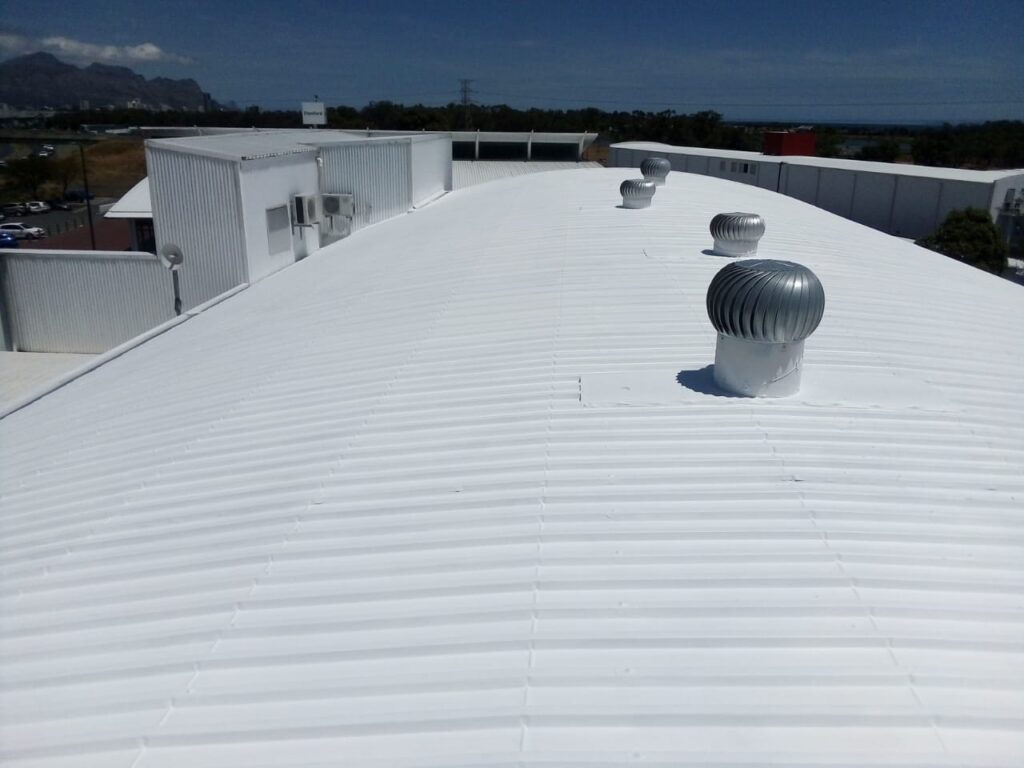
Industrial facilities commonly use corrugated metal and profile sheeting that is susceptible to rust and corrosion over time. MetalCoat combined with HydroFlex creates a protective barrier that prevents corrosion whilst accommodating the thermal movement that large metal roof sections experience.
Large concrete roof decks on warehouses and distribution centres carry significant structural loading. The Armtek System combined with HydroFlex provides a seamless barrier that accommodates building movement and resists the ponding common on expansive flat surfaces.
Many older industrial buildings carry asbestos sheeting that has become brittle and porous over time. AsbestosFlex is applied directly to asbestos roofing, providing a protective waterproofing layer without the need to disturb or remove the existing sheeting.
Factory floors, loading docks, and structural slabs face constant mechanical load alongside moisture exposure. Correct waterproofing protects the structural concrete from reinforcement corrosion whilst withstanding the traffic and loading the structure carries.
Subfloor areas, plant rooms, and below-ground storage need protection from hydrostatic pressure and ground moisture. Hydroblock liquid membrane and DampEnd cementitious barrier are matched to the demands of below-grade industrial applications.
Scheduled inspections that identify deterioration before it disrupts operations, extending system life and maintaining warranty compliance.
Large surface areas and continuous operation are the defining challenges. Because liquid systems are cold-applied in sections, portions of the facility can remain active whilst adjacent areas are treated. No open flame. No forced shutdown.
Chemical exposure, temperature extremes, and mechanical vibration from machinery place specific demands on any waterproofing system. Sealtek products are formulated to accommodate building movement and resist the industrial exposures that degrade standard coatings.
Temperature cycling in refrigerated and agricultural environments places repeated stress on roof membranes. Sealtek liquid systems maintain flexibility across temperature extremes, providing reliable protection in conditions that cause standard coatings to fail prematurely.
Food-safe environments require products that contain no hazardous chemicals. Sealtek waterproofing products meet these requirements, making them suitable for application in and around food-sensitive production areas.
Industrial-scale waterproofing projects require contractors who can manage large surface areas, coordinate work around production schedules, and document the application properly for compliance and insurance purposes.
Sealtek Accredited Applicators complete training in surface preparation protocols, application techniques, and problem-solving for the complex substrates common in industrial construction. They work to certified installation procedures with multi-stage quality control checkpoints. The result is a verifiable record of what was done, how it was done, and by whom. That documentation matters when you need to demonstrate compliance or support an insurance position.
Step 1: You get in touch
Tell us about the facility, the issue, and the operational constraints we need to work around. We connect you with the accredited contractor for your area.
Step 2: On-site assessment.
Your local contractor inspects the structure, evaluates the substrate condition, and discusses a schedule that protects the facility without interrupting production.
Step 3: Quote and specification.
The quote reflects the scale of the project, the products required for the specific substrate, and a programme that fits your operational needs.
Step 4: Professional installation.
Cold-applied liquid systems allow work to proceed section by section, often without requiring a production shutdown. The 5-year written guarantee applies from completion.