
Reading time: 4 minutes
You’ve had the flat roof patched. Maybe twice. The contractor found where the water was getting in, sealed the joint, and told you it was sorted. Then the next heavy downpour rolls through Cape Town or Somerset West, and that familiar damp patch creeps back across the ceiling. Almost exactly the same spot.
If this sounds like your experience, you’re not dealing with bad luck. You’re not dealing with an incompetent contractor either. You’re dealing with a design reality that traditional waterproofing methods struggle to overcome. Flat concrete slab roofs hold water. They’re meant to shed it, but “flat” is never truly flat. The shallow gradients on most residential slabs leave water sitting on the surface long after the rain stops, and every joint, overlap, and seam in a conventional waterproofing system becomes an entry point under that sustained pressure.
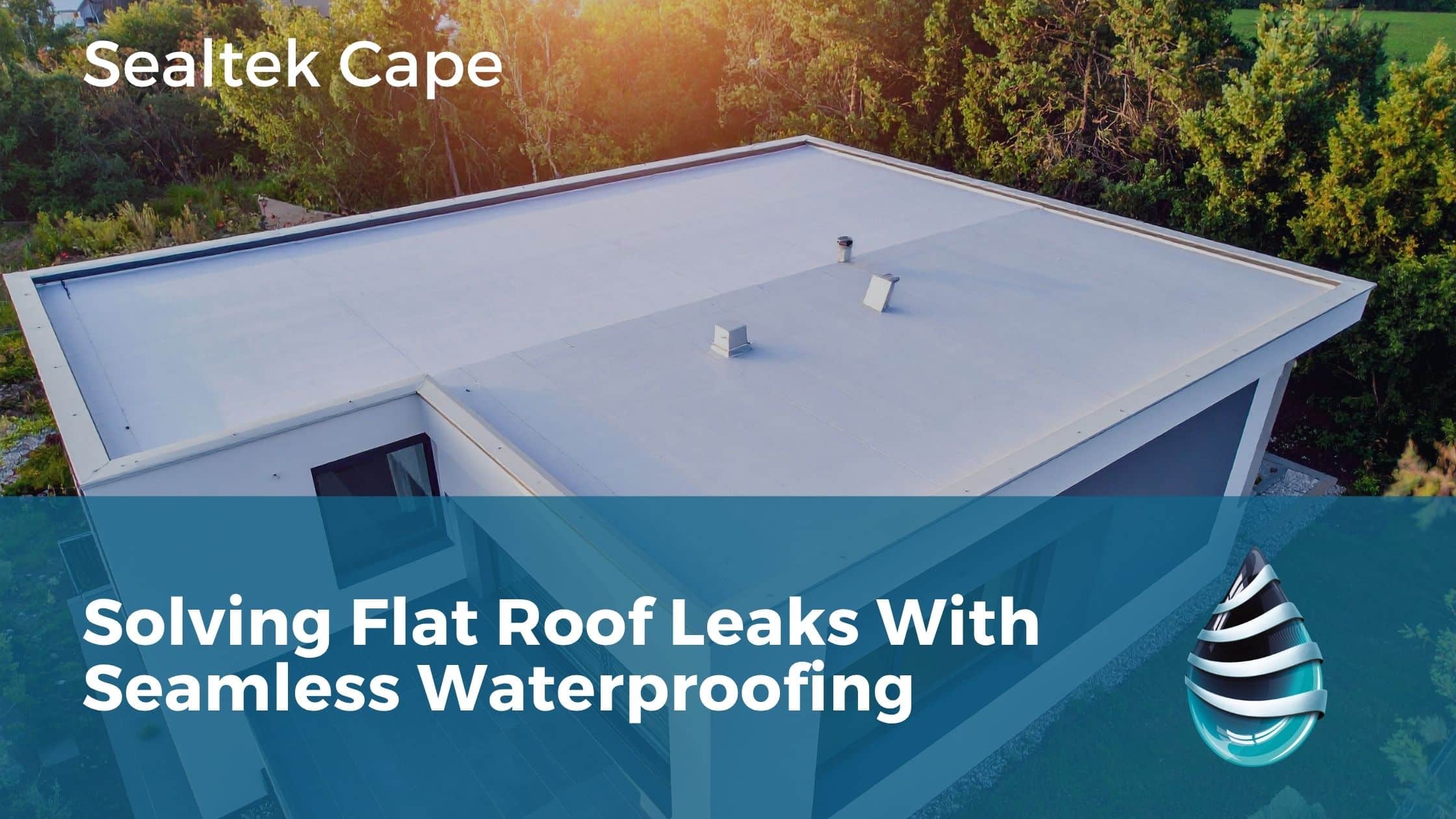
The fix isn’t another patch over the same joint. It’s removing the joints entirely. Seamless liquid-applied waterproofing technology, like the Hydroflex Rubber coating system, creates a continuous membrane across the full roof surface with no weak points for water to exploit. If you’ve been through multiple flat roof repairs that keep failing, seamless flat roof waterproofing solutions take a fundamentally different approach.
Why Flat Roofs Fail Where Pitched Roofs Don’t
A pitched roof sheds water by gravity. Rain hits the surface and runs off within seconds. Even if a tile cracks or a sheet lifts, the water moves too quickly to find its way through most gaps.
Flat roofs don’t get that advantage. Water lands on the slab and stays there. During the Western Cape’s winter rainfall season, it can pool for hours after a sustained downpour. Sometimes days, if drainage outlets are partially blocked or the slab has developed low spots. The industry calls this ponding, and it’s the single biggest stress test any flat roof waterproofing system will face.
Traditional membrane systems, whether torch-on bitumen, sheet membranes, or some painted-on coatings, rely on overlapping sections bonded together at seams. Dry, those seams hold fine. Under ponding water, the hydrostatic pressure works at those joints continuously. Meanwhile, temperature cycling causes the slab to expand and contract. That flexes the membrane and stresses the bond at every overlap point. Over months and years, repetitive movement opens micro-gaps right where two sheets meet.
So your repair keeps failing in the same spot for a reason. The patch addresses a gap at one specific joint. But the actual vulnerability is that joints exist at all.
How Seamless Waterproofing Works
Liquid-applied seamless waterproofing takes a different approach entirely. Instead of laying sheets and bonding them at the edges, a liquid rubber coating goes onto the concrete slab as a wet application. It cures into a single continuous membrane. No joints. No overlaps. No seams to fail.
The Hydroflex Rubber system shows how this works in practice. The liquid coating is applied directly onto a prepared concrete substrate and cures to form a flexible, rubber-like membrane bonded to the full surface area of the slab. One unbroken layer, with no edge bonds for ponding water to work its way under.
Flexibility matters just as much as the seamless coverage. Concrete slabs move. They expand in heat, contract when it’s cold, and shift as the building settles over time. A rigid waterproofing system, or one that loses flexibility as it ages, will crack under that movement. Hydroflex Rubber maintains its elasticity throughout its working life, stretching and recovering with the slab instead of pulling away from it. In a climate like the Western Cape’s, where a flat roof in Stellenbosch or the Helderberg can swing through a wide temperature range between a winter morning and a summer afternoon, that flexibility isn’t a bonus feature. It’s fundamental to long-term performance.
Ponding Water: The Problem That Won’t Go Away
One practical advantage of a seamless membrane is its tolerance for ponding. Most flat residential roofs in South Africa weren’t built with textbook drainage falls. Some degree of water pooling after rain is a design inevitability rather than a defect.
Traditional systems need that water gone to perform. Standing water degrades bitumen-based membranes, softens adhesive bonds at seams, and accelerates UV breakdown on exposed surfaces. Hydroflex Rubber is formulated to resist prolonged water contact. It doesn’t soften or delaminate under standing water the way older technologies do.
None of this means drainage should be ignored. A professional assessment will identify whether improving drainage falls or clearing blocked outlets should form part of the solution. But the waterproofing system itself can handle the ponding that’s going to happen regardless, rather than depending on perfect drainage as a precondition.
What the Application Looks Like
For homeowners who’ve been through disruptive roof repairs before, the process is worth understanding upfront.
The existing roof surface stays in place. No stripping of old materials, no demolition, no heavy equipment on your property. The concrete slab gets cleaned, primed, and any active cracks or damage points are addressed before the liquid coating goes on across the full surface.
Surface preparation is the stage that matters most. Failed waterproofing applications usually aren’t a product problem. They’re a prep problem. Contaminants on the concrete, loose material, trapped moisture in the slab: any of these can compromise adhesion. A professional applicator assesses the substrate and prepares it properly before anything goes on. This is where your choice of contractor counts as much as the product itself.
The coating builds up in multiple passes to reach the required thickness. A standard residential flat roof usually completes within a few days. You stay in the house throughout. No exposed roof structure left open to the weather overnight.
When Seamless Waterproofing Isn’t Enough on Its Own
A seamless membrane handles the vast majority of residential flat roof situations. But some problems sit deeper than the waterproofing layer.
Structural cracking from foundation movement or building settlement won’t stop just because there’s a membrane on top. The waterproofing might mask the symptom temporarily, but the structural issue needs addressing first. The same goes for exposed rebar or spalling concrete where the slab’s reinforcement has been compromised. Structural repair comes before waterproofing in those cases.
Drainage that’s blocked or undersized, causing water to pool deeper than 50mm, may need physical correction before waterproofing alone can deliver a lasting result.
A proper diagnostic assessment before any product goes on the roof is what separates a lasting repair from another temporary fix. A qualified waterproofing specialist will tell you whether your flat roof is a straightforward waterproofing candidate, or whether underlying issues need attention first. That honesty upfront saves you from paying for work that was never going to hold because nobody looked at the full picture.
Stop Patching and Start Solving
If you’ve been through repeated flat roof repairs that keep failing at joints and overlaps, a seamless liquid-applied system like Hydroflex Rubber addresses the root cause rather than the symptom. It removes the joints where failure occurs and creates a continuous protective membrane built to handle ponding water, structural movement, and the Western Cape’s demanding climate. Contact Sealtek Cape to arrange a professional flat roof assessment across Cape Town, Somerset West, Stellenbosch, Hermanus, and surrounding areas, and find out whether seamless waterproofing is the right solution for your roof.